
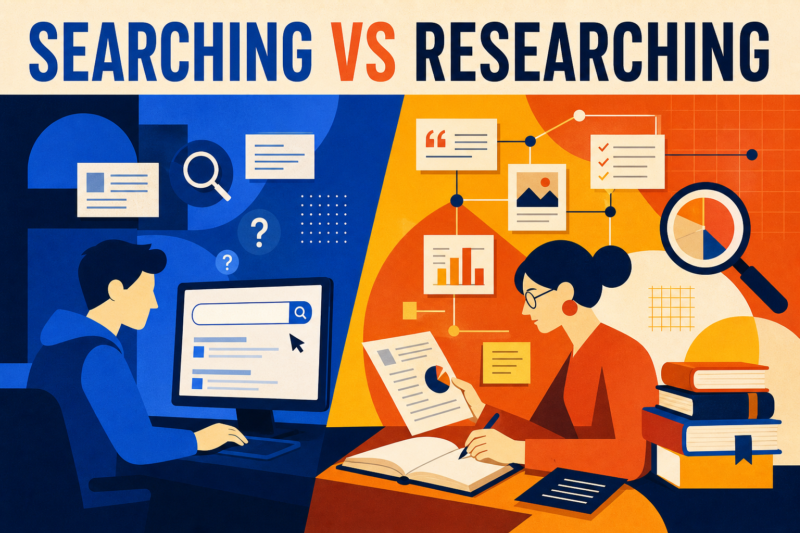
Google can certainly be part of research. It is an extremely useful tool for discovering information, locating sources and getting an initial understanding of a subject. But searching is only one small part of the research process.
Research is the systematic process of asking a question, finding relevant information, evaluating the quality of that information, comparing different sources, identifying patterns and contradictions, and using the evidence to reach a reasoned conclusion.
The important word there is evidence.
Good research isn't about finding something that agrees with what you already think. It is about discovering what the available evidence actually tells you.
And that distinction matters whether you're writing an academic paper, investigating a new market, researching a competitor, developing a product or simply trying to make a better-informed decision.
Searching and Researching Are Not the Same Thing
Imagine you want to answer the question:
"Is remote working more productive than working in an office?"
A quick Google search might return articles with headlines such as:
- "Remote Workers Are More Productive Than Office Workers"
- "Why Working From Home Is Killing Productivity"
- "Employees Demand Flexible Working"
- "Businesses Are Ordering Staff Back to the Office"
Within a few minutes, you could probably find an article supporting almost any conclusion you wanted.
That's searching.
Research begins when you start asking questions about what you've found.
Who conducted the study?
How many people participated?
When was the research carried out?
Which industries were included?
How was "productivity" measured?
Was the research independently conducted or commissioned by a company selling remote-working software?
Are other studies reaching similar conclusions?
Suddenly, the task becomes much more interesting — and much more useful.
Start With the Question, Not the Search Box
One of the most important parts of research happens before you search for anything.
You need a good research question.
Consider the difference between:
"Tell me about electric cars."
and:
"What are the main financial and practical barriers preventing UK drivers from switching from petrol cars to electric vehicles?"
The second question gives the research direction.
It tells you that you're interested in UK drivers, financial considerations, practical barriers and the transition from petrol vehicles to EVs.
That makes it much easier to determine what information you actually need.
Practical tip
Before beginning your research, write down three things:
- What am I trying to discover?
- Why do I need this information?
- What would a useful answer allow me to do?
If you can't answer those questions, you probably aren't ready to start searching yet.
Finding Information Is Only the Beginning
Google is excellent at finding information.
But finding information isn't the same as establishing whether that information is reliable.
Suppose you're researching a market for a new product and discover a website claiming:
"The global market will be worth £20 billion by 2030."
That sounds impressive.
But where did the figure come from?
Follow the source.
You may discover that one website quoted another website, which quoted a press release, which referred to a market report that you cannot actually access.
You now have a widely repeated statistic — but very little evidence supporting it.
This happens surprisingly often.
A better approach is to work backwards towards the original source whenever possible.
Government statistics, academic research, regulatory bodies, company filings, industry organisations and original datasets can often provide stronger evidence than an article summarising someone else's findings.
Not All Sources Are Equal
A professional-looking website doesn't automatically make its information trustworthy.
When evaluating a source, consider:
Authority: Who produced the information? Do they have relevant expertise?
Evidence: Does the source explain where its claims and figures came from?
Date: When was it published or last updated?
Purpose: Is the source trying to inform, persuade or sell something?
Methodology: If research was conducted, how was it carried out?
Corroboration: Can the important claims be confirmed elsewhere?
None of these questions necessarily disqualifies a source.
A company selling cybersecurity software, for example, may publish an excellent cybersecurity report. You simply need to understand the context in which the information was produced.
Good Research Looks for Disagreement
One of the easiest research mistakes is confirmation bias.
You believe something is true, search for it, find evidence supporting your belief and stop.
Suppose you believe small businesses prefer monthly software subscriptions.
Searching:
"Why small businesses prefer monthly SaaS subscriptions"
is likely to produce exactly the evidence you're looking for.
Try deliberately challenging your assumption:
"Why small businesses dislike SaaS subscriptions."
Then perhaps:
"Small business preference monthly vs annual software subscription."
You may discover that the reality is considerably more nuanced.
That's valuable.
Good research should occasionally make you uncomfortable because it challenges what you expected to find.
Research Means Connecting the Dots
Individual facts are useful.
The real value often comes from connecting them.
Imagine you're researching whether there is an opportunity for a new software product aimed at small businesses.
You discover that:
Small businesses spend significant time on administrative tasks.
Separate research suggests many business owners are increasingly using AI.
Competitor research reveals numerous specialist AI tools but relatively few products bringing several administrative functions together.
Customer discussions repeatedly mention frustration with managing multiple subscriptions.
Each piece of information is interesting.
Together, however, they might indicate a potential market opportunity.
That process — collecting evidence, comparing it and identifying what it means collectively — is where research becomes analysis.
Keep Track of Where Everything Came From
Another common problem appears after hours of research.
You remember an excellent statistic.
You remember reading it.
You may even remember roughly what it said.
But you can't remember where it came from.
Recording sources as you work prevents this.
For each useful piece of information, capture:
- the source
- author or organisation
- publication date
- relevant quotation, statistic or finding
- link or reference
- why the information matters
- any concerns about reliability
This becomes particularly important when research involves dozens or hundreds of sources.
It also makes it possible for somebody else to verify your conclusions.
Know When You've Researched Enough
Research can easily become endless.
Every answer creates another question. Every source leads to another source.
At some point, you need to stop.
A useful stopping point is when you begin experiencing information saturation — new credible sources are mostly repeating evidence or arguments you've already encountered.
Ask yourself:
Have I answered the original question?
Have I considered credible opposing evidence?
Are the important claims supported by multiple reliable sources?
Are there significant gaps that could change my conclusion?
If the answers are satisfactory, you probably have enough information to move from research into reporting or decision-making.
AI Has Changed Research — But Not the Principles
AI tools have made research considerably faster.
They can help generate research questions, identify areas worth investigating, summarise complex material, compare documents and organise large quantities of information.
But AI doesn't remove the need for research discipline.
In fact, it makes source checking even more important.
An AI-generated answer may sound extremely convincing while containing outdated information, misunderstood evidence or even incorrect references.
The same principle therefore applies:
Don't just ask, "What does the answer say?"
Ask:
"What evidence supports the answer?"
AI should help you investigate evidence, not eliminate the need for evidence.
A Simple Research Process Anyone Can Use
You don't need to be an academic researcher to adopt better research habits.
For most everyday projects, a straightforward process works remarkably well:
- Define the question clearly.
- Break the question into smaller areas to investigate.
- Search broadly to understand the subject.
- Identify authoritative and original sources.
- Evaluate each source for reliability and relevance.
- Look deliberately for conflicting evidence.
- Record important findings and their sources.
- Compare the evidence and identify patterns.
- Note uncertainties and gaps rather than hiding them.
- Draw conclusions based on the evidence you've collected.
Notice that Google appears mainly around steps three and four.
There's quite a lot of work after pressing Search.
Conclusion: Search Finds Information. Research Creates Understanding.
Google has transformed our ability to access information, and it remains an incredibly valuable research tool.
But it hasn't replaced research.
Typing a question into a search engine and reading the first few results gives you information. Research requires you to go further.
You need to question sources, verify claims, compare evidence, investigate opposing viewpoints, understand context and ultimately decide what all that information actually means.
That distinction is increasingly important in a world where we aren't suffering from a shortage of information.
We're surrounded by it.
The challenge now is determining which information deserves our trust, how different pieces of evidence fit together, and what conclusions we can reasonably draw from them.
That's what turns a Google search into research.